TRAFFIC QUINTET


Divine Féminin
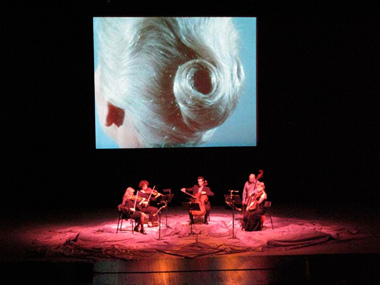
Musical drama in four acts (2009)
First performance: September 26th, 2009 at Musica Festival, Strasbourg
- Design, direction: Dominique Lemonnier
- Transcriptions of works by: Pascal Dusapin, Alexandre Desplat, Bernard Herrmann, Jerry Goldsmith, Alex North, Philip Glass, Air, Gabriel Yared
- Art direction: Alexandre Desplat
- Video Design "Tribute to Jacques Monory": Ange Leccia
- Editing: Lise Fernandez
- Set designer: Bruno Cohen
Traffic Quintet
- Violin: Dominique Lemonnier, Anne Villette
- Viola: Estelle Villotte
- Cello: Raphaël Perraud
- Double bass: Philippe Noharet
Produced by Alexandre Desplat for Galilea Music
With the support of the Fondation d'entreprise Hermès
and the SACEM Action Fund
After a first, fruitful experience in the music of Nouvelle Vague films, the Traffic Quintet is now tackling the rhythmical and symphonic structures of composers who have been working – in many a film – with women who are mysterious, pernicious, terrified or fragile, even icily blonde, like those whom Hitchcock liked to direct...
From Medea to Marilyn
The traffic quintet performs film music with an original formation - the string quintet, while combining and punctuating their musical performances with visual creations.
After a successful first show dedicated to French Nouvelle Vague cinema, Dominique Lemonnier has created a new program around actresses who, each in their own way, have become myths.
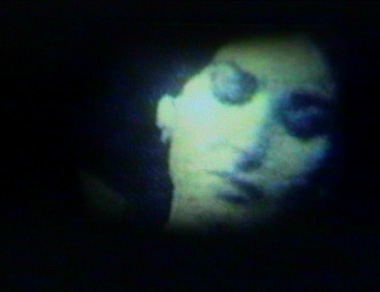
Whether they have been long incorporated into the collective unconscious (Marilyn Monroe, Ingrid Bergman or Maria Callas) or whether they are currently in the process of becoming icons (Nicole Kidman, Sharon Stone and Isabelle Adjani), these female figures accompany us in the search for the ancient and universal myth of Medea.
We see Maria Callas, during her only appearance on the silver screen, in the role of Pier Paolo Pasolini's Medea. This mythical figure is the common theme of Divine Féminin, a musical drama in four acts, each one beginning with a musical fragment of "Medea material" from Pascal Dusapin's opera.
Murderous, deep, lost women - together the creator Dominique Lemonnier and the videomaker Ange Leccia revisit the vibrant theme of the "eternal feminine", and also pay homage to the painter most inspired by American film noir, Jacques Monory. "Une espèce de cinéma des songes" - "A kind of cinema of dreams" (J. Monory) is born of their encounter with the composer Alexandre Desplat. At the crossroads of genres and disciplines, the traffic quintet confirms its mission: to do film music justice by associating it with elaborate artistic projects.
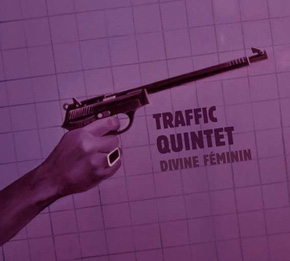
CD Divine Féminin
Sharon Stone daring the obvious, Janet Leigh on the way to a fatal motel, Ingrid Bergman with her elbow on a piano, and Marylin Monroe, of course, so alone, a year before her death... They pass by, invisible.
Similarly, in dreams, other actresses emerge, with a ghost threading its way through them, that of Medea, who killed her children, that same Medea with the features of Callas, La Divina, her only film role.
- Basic Instinct (J. Goldsmith)
- Vertigo (B. Herrmann)
- Psycho (B. Herrmann)
- Medeamaterial I (P. Dusapin)
- Fahrenheit 451 (B. Herrmann)
- The Misfits I (A. North)
- The Misfits II (A. North)
- I'm through with love (F. Livingston/M. Malneck/G. Kahn)
- Medeamaterial II (P. Dusapin)
- Chinatown (J. Goldsmith)
- The Hours (P. Glass)
- Virgin Suicides (Air)
- Medeamaterial III (P. Dusapin)
- Birth - Elegy (A. Desplat)
- Birth - Valse (A. Desplat)
- As time goes by (H. Hupfeld)